WRS Crew had the first operating session is a few months. Sorry no pictures more on that later.
Since the last operating session the WRS has changed, with the addition of the MEC/South Yard replacing the MEC Interchange at Greenfield.
So the Grand Plan was to have an operator work the new yard and build the out going trains. There are four trains that depart from this yard during the session and three that arrive. In total 43 cars are required in the yard at the start of the operation. The problem is the present stage yard tracks can only hold maybe thirty cars at the most. There were cars parked on the switches and leads to the yard. And of course, the cars for the first train were at the far end of each track. Something was said about dragging the last engineer, who worked the yard, behind the switcher.
About an hour after starting, Barry finally had the yard cleaned up and the first train was about to depart. This time allowed the other members of the Crew a lot of time to catch up on what happened during the summer.
Pierre was busy working the revised Paper Mill. Glen was switching the town of Roseton and Bruce switched Dogwood. Bruce was using a BAR GP38 with sound, which his son Andrew had just finished. Wayne was busy with his pair of GP 40 MEC units on the main line.
Of course there were the usual issues with a layout that has not be operated during the summer and will keep the maintance crew busy for awhile.
Adjustments will be made to the Yard operations before the next session to improve travel flow.
Oh the pictures, by the time we got the first train out of the Yard, I was to busy to take pictures... that is my story ...
later
Doug
Monday, September 20, 2010

Tuesday, September 7, 2010
A few pictures from PEI
The last weekend in August, I made a trip to Summerside. It was going to be for "Railfest", the annual setup of the UMG to operate on the layout. But this year it was replaced with us operating on Scott's Bayside & Tidewater and Derwin's Canadisle railroads. Below are a few pictures from the weekend.

Abel and Scott at Chappellton

Derwin getting his train arranged

Allan and Ashton working Stevenville

Looking from the Bridge just past Derwin's Drop towards Stevenville.

Allan checking out Ashtown

Abel and Scott at Chappellton

Derwin getting his train arranged

Allan and Ashton working Stevenville

Looking from the Bridge just past Derwin's Drop towards Stevenville.

Allan checking out Ashtown
We started the day of operating at Derwin's layout with two sessions.
Then it was back to Scott's for supper and then an operating on his layout that night.
Sunday morning a second session was held at Scott's.
I had a great time
Doug
Sunday, August 15, 2010
Changes ... Changes
About a year ago the first phase was started, when the section between Roseton and Dogwood was redone. The area called Junction was removed, along with the Blue Ridge Branch. Work as continued on this phase with the installation of a back drop behind Dogwood and the development of the area between Marc's Printing and the White River Bridge as discussed in past posts.


Now for the main reason for Phase Two, the South Yard.
Below are a couple pictures of the present arrangement of the South Yard/ MEC Yard. Once the area from Dogwood to Roseton has had more scenery added, the Yard will be re-arranged.


That is the update of the changes to date. The revised layout was operated as part of the Grand Tour, which I got notice of the date a week after I started this work.
later
Doug
In June, Phase Two was started. The Paper Mill was disconnected from the layout at Greenfield. The connection with MEC was torn up and the MEC Yard was also disconnected from the layout.
Now it was time to install new benchwork to allow for a 180+ deg corner to connect Dogwood with White River Paper Company. As part of this new benchwork was the completion of the backdrop started in Dogwood.
Now Greenfield is the new home of Green Mountain Limestone's operations.


This is the view from Farmer John's field of Greenfield and Green Mountain Limestone. The town of Greenfield may stay or may not.
Now it was time to install the other side of the backdrop before installing the new framework. One of the issues with the old Paper Mill, was the ground was not even because of the way I build the modules. This time, there is no modules, it is all "L" girder under the Mill. The new Mill is a little longer then the older version.

This is the view from the end of the bench work, on the right is the "hole" connecting to Greenfield.

This view has the dry power unloading track on the left, in the center is the Shipping Building, on the front right is the two tracks for the Mill yard. The main line curves around the Shipping Building to end up as the third track from the right.

This shows the far end of the Paper Mill, with the Receiving Warehouse in the center and the Boiler Plant on the left. The main line (third track from the left) goes between these two building. On the right is the Chemical Unloading building and on the left is other end of the Mill yard.
With the new arrangement, there are a few more spots to unload cars. More on this later.
Now for the main reason for Phase Two, the South Yard.
Below are a couple pictures of the present arrangement of the South Yard/ MEC Yard. Once the area from Dogwood to Roseton has had more scenery added, the Yard will be re-arranged.


That is the update of the changes to date. The revised layout was operated as part of the Grand Tour, which I got notice of the date a week after I started this work.
later
Doug
Saturday, July 31, 2010
Fall River & Eastern Derailment
During the operating session on the Fall River & Eastern last weekend, there was a major derailment. The Local Peddler Crew began a reverse motion on the mainline, however the switch for Golden Flame siding was still set for the siding. The accelerating train derailed the two covered hoppers on the siding, pushing the last covered hopper into the Tower, moving it from its foundation. Photo below is from the Management at Fall River & Eastern.

In the accident report the engineer said he was told by his brakeman to back up the train and the switch for Golden Flame siding had been returned to the Main.
Normally the brakeman would have be been responsible for the accident but he works for Fall River & Eastern and is related of the President of the Railroad and the engineer was visiting from another railroad and has a "history".
Clean up crews have been working on site and have the covered hoppers back on the tracks and have been send to the repair shop for inspection. The engineers will be reviewing the fountion and structure of the tower to see if it can be saved.
later
Doug
Sunday, July 25, 2010
Grand Tour
After two months of trying to find a date which worked for all parties, the chosen date of July 24th finally arrived and three members of the Codiac Operators Group , Jim, John and Milne were on their way for the Grand Tour.
The first stop was Dave's Fall River & Eastern. Joining the tour were the three CEOs of the railroads plus one of regulars of the WRS crew, Glen. This will be only the second formal operating session on the railroad, so we not sure how things were going to happen. The session started with Milne running the morning Passenger Train, Jim took the controls of the North Thru Freight, John and Glen started working the River Yard (the main yard on the FR&E) and Wayne when to the North Yard to work the South Peddler. After completing the passenger run, Milne headed to the Brewery to do a little local switching. Jim and Dave headed out with the Meat Plant Local. Wayne was still working the South Peddler. I was still doing the paper work for the rest of the session.
After Jim and Dave finished the Meat Plant Local, Jim headed out with the South Thru Freight. Milne had arrived at the North Yard with his local, so he took a break and ran the RDC service. Wayne was just finishing up the South Peddler and had arrived at River Yard, which was keeping John and Glen busy.
Wayne departed River Yard with the North Peddler, Milne headed back to North Yard to pick up his local to return to the Brewery and complete its run, and Jim and Dave departed with the Local Peddler.

On the right is Dave and Jim working the Local Peddler

Wayne heading out with North Peddler

Glen and John checking out their handy work in River Yard.

Jim and Wayne talking between runs.
Milne was moving so quickly his pictures did not turn out.
After everyone had completed their work, it was time to head out for lunch.
After lunch, we all headed to Wayne's Maine Central Nottingham Sub. After reviewing the lastest additions to the railroad, it was time to operate a few trains on the Sub. A formal operating plan is still in development. (The link to Wayne's Railroad is on the sidebar) Sorry no pictures, forgot the camera in the car.
Now for the last stop, the White River Southern. We lost one operator when Dave had to leave for another appointment.
John chose to operate the Roseton Switcher, Milne took the Dogwood Switcher and Jim got brave and headed for the Paper Mill. After get things setup in the new MEC Yard, Glen joined Jim at the Mill. Wayne fired up his MEC GP40s to run the Mainline Service.

Milne busy at Dogwood

John at Roseton working with Wayne as he makes his pickups and set outs.

Jim and Glen working at the revised Paper Mill
The first stop was Dave's Fall River & Eastern. Joining the tour were the three CEOs of the railroads plus one of regulars of the WRS crew, Glen. This will be only the second formal operating session on the railroad, so we not sure how things were going to happen. The session started with Milne running the morning Passenger Train, Jim took the controls of the North Thru Freight, John and Glen started working the River Yard (the main yard on the FR&E) and Wayne when to the North Yard to work the South Peddler. After completing the passenger run, Milne headed to the Brewery to do a little local switching. Jim and Dave headed out with the Meat Plant Local. Wayne was still working the South Peddler. I was still doing the paper work for the rest of the session.
After Jim and Dave finished the Meat Plant Local, Jim headed out with the South Thru Freight. Milne had arrived at the North Yard with his local, so he took a break and ran the RDC service. Wayne was just finishing up the South Peddler and had arrived at River Yard, which was keeping John and Glen busy.
Wayne departed River Yard with the North Peddler, Milne headed back to North Yard to pick up his local to return to the Brewery and complete its run, and Jim and Dave departed with the Local Peddler.

On the right is Dave and Jim working the Local Peddler

Wayne heading out with North Peddler

Glen and John checking out their handy work in River Yard.

Jim and Wayne talking between runs.
Milne was moving so quickly his pictures did not turn out.
After everyone had completed their work, it was time to head out for lunch.
After lunch, we all headed to Wayne's Maine Central Nottingham Sub. After reviewing the lastest additions to the railroad, it was time to operate a few trains on the Sub. A formal operating plan is still in development. (The link to Wayne's Railroad is on the sidebar) Sorry no pictures, forgot the camera in the car.
Now for the last stop, the White River Southern. We lost one operator when Dave had to leave for another appointment.
John chose to operate the Roseton Switcher, Milne took the Dogwood Switcher and Jim got brave and headed for the Paper Mill. After get things setup in the new MEC Yard, Glen joined Jim at the Mill. Wayne fired up his MEC GP40s to run the Mainline Service.

Milne busy at Dogwood


John at Roseton working with Wayne as he makes his pickups and set outs.
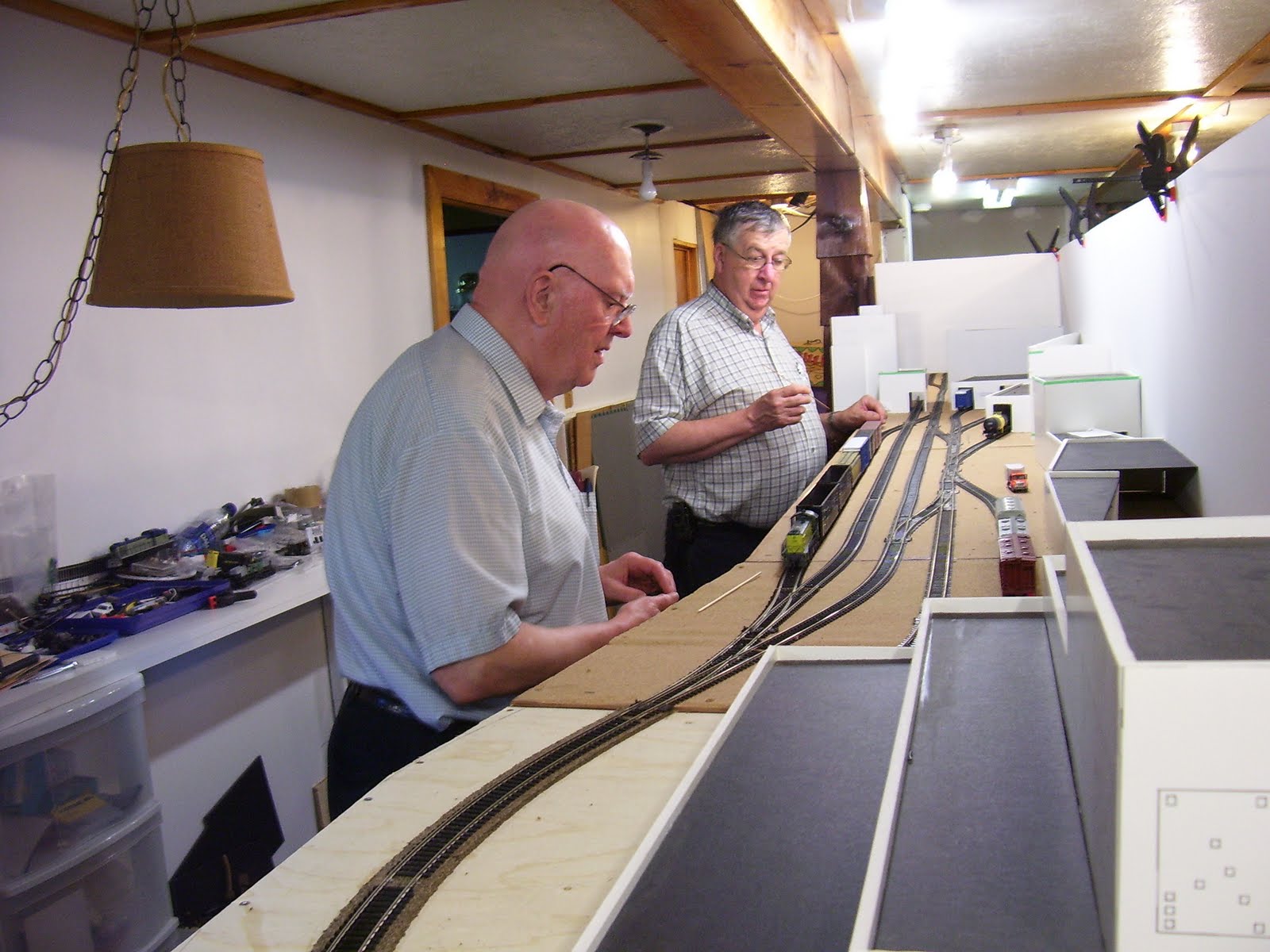
Jim and Glen working at the revised Paper Mill
Six hours after they arrived, it was time for Jim, John and Milne to head back North. Hopefully they enjoyed their visit and will make a return trip in the near future.
later
Doug
Thursday, June 10, 2010
Eastern Snagal
I needed to make a few trees for the hill behind the passenger station in Dogwood. The following is a brief description of how I made them.

These are the materials I used to make these trees. Most for them were found at the local Dollar store. The branches are made from a product call "Sisal Sheets", which is dyed sisal string glued into a mat. You get 3 sheets for a dollar. Each sheet will make three to four trees. The trunk is from BBQ Bamboo Skewers, which are 12 " long 1/4" dowel which has the last 3/4" sharpen to a point and come 36 to a package. Toothpicks, white glue, and scissors round out the material for the first stage.

The sheets are cut into squares of different sizes including, 2"x 2", 1.5" x 1.5" and 1" x 1". Since these squares are too thick, they are divided in half as shown above.
The next step is to shorten the skewers to the height of tree you wish to make. I made mine, five to seven inches tall. Then I drilled a small hole in the base and installed a half of a round toothpick to allow for installation of the tree later.

The next step is put the squares on the shewer, by pushing the square over the point of the skewer. Once the square is in place add a little white glue around the skewer at the square. Keep adding squares about 3/8" apart until the tree is finished. As you get closer to the top of the tree, I downsized the size of the square.

This is a completed tree. Notice how the squares get smaller as you go up the tree.

The next step is to pick and pull at the squares to loosen up the fibres to end up with a tree above. You will have to trim off pieces of fibre to get the general shape you require.
Next the tree is painted. I used grey primer, but others have used green or brown.

For the next step you will need a tub, hair spray and green ground foam. You take the tree from above, spray it with hair spray from all directions and then apply the ground foam to the tree. If you do it in the tub, you can recover the excess foam to be used on the next tree. Remeber to shake the tree over the tub to remove any loose foam.

This is the finished product, an Eastern Snagal ready to plant.

This is the hill behind the station with a few Eastern Snagals installed.
If you wish to make an spruce or evengreen. Just thin your squares to only one or two layers of sisal string before installing them. Then shape the squares as required. The picking and pulling step will not be required for these trees.
Now it is time for me to get back at making a few more Eastern Snagals, I still have a few more areas that need a few trees.
later
Doug
Friday, May 28, 2010
Update
Last weekend was the annual convention for the local model railroaders in Saint John, NB, which many of the WRS Crew attended. As part of the convention there were clinics presented on many different subjects. I was able to attend a few of them , in which I was able to learn a few new things. Now just need to spend a little more time in the Shop to put this new knowledge to work. Between clinics and other functions, there was also a chance to talk to a few other people about issues in operating a railroad.
Was able to pick up a few items for the WRS on Friday and Saturday.
Sunday was spend visiting five of the local railways. All of these railroads have their roots in New Brunswick. Three are based on real railways, and two are based if another railway operated them. Two of these railways, I had a chance to operate on about a year and half ago. The other three it has been longer since I visited them. All of the railways have had additions and improvements, some major and some you have to look for, since my last visit. Looking forward to getting another chance to operate on three of the layouts soon.
On the WRS, the track gang has finished the maintenance of the ballast on the line from the bridge to Marc's Printing in Dogwood. The site for the new passenger station in Dogwood is almost completed. The crews have also been working in Greenfield on some of the track work that caused a problem in the last operating session.
The WRS will be operating again soon.
later
Doug
Subscribe to:
Posts (Atom)